Taking a Suitcase on Tokyo TrainsGreen Cars, Limited Expressesand the Shinkansen
This article contains affiliate links
This is Part 6 of our guide to paid seats on Tokyo trains. In Parts 1 and 2 we promised to come back to luggage. Here it is.
Where does the suitcase go?
You arrive in Tokyo with a large suitcase, a backpack and, on the way home, a few bags of souvenirs. Then you step into a JR Green Car or a limited express and wonder where any of it is supposed to go.
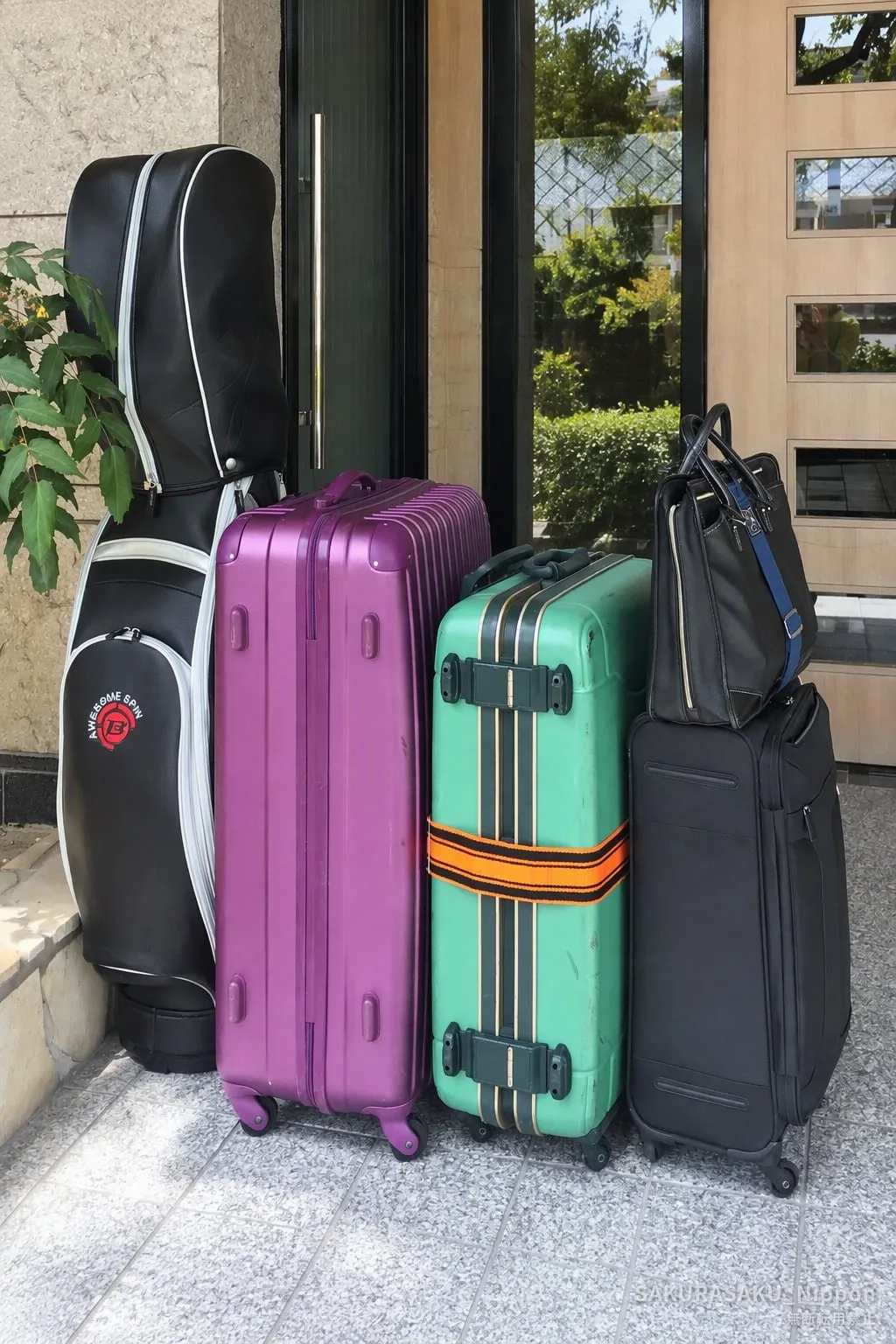
Three suitcases, a golf bag and a tote. Luggage adds up fast.
Here is the answer that surprises most people. The double-decker Green Cars on Tokyo’s JR local trains have no space set aside for large luggage (JR East, Green Cars on Local Trains).
In this part we go through the size limits, where to put your bags on each kind of train, the manners locals expect, and how to skip carrying your luggage altogether.
How big can your luggage be?
JR East lets you bring luggage on board for free within these limits (JR East, Oversized Luggage Guide).
| Rule | Limit |
|---|---|
| Size | Length, width and height add up to 250 cm or less, and no side over 2 m |
| Weight | 30 kg or less per piece |
| Number | Up to 2 pieces (umbrellas, canes, handbags and other personal items do not count) |
Anything over these limits may not come on board.
On the Tokaido Shinkansen, book a seat for your big bag
This is the one rule that can cost you
On the Tokaido, Sanyo and Kyushu Shinkansen, a bag whose three sides add up to 161 to 250 cm counts as oversized baggage. To bring one, you reserve a seat with an oversized baggage area, the space behind the last row of seats (JR Central, Oversized Baggage).
The seat costs no more than an ordinary reserved seat. But if you board with an oversized bag and no reservation, you pay a ¥1,000 fee. Bags over 250 cm are not allowed at all.
You can reserve online with smartEX, at a reserved-seat ticket machine, or at a ticket office, where you should tell the staff you have an oversized bag. Japan Rail Pass holders can ask at the ticket office or use the JAPAN RAIL PASS Reservation service (JR Central, Oversized Baggage).
These seats are on Nozomi, Hikari and Kodama trains, in some of the reserved cars.
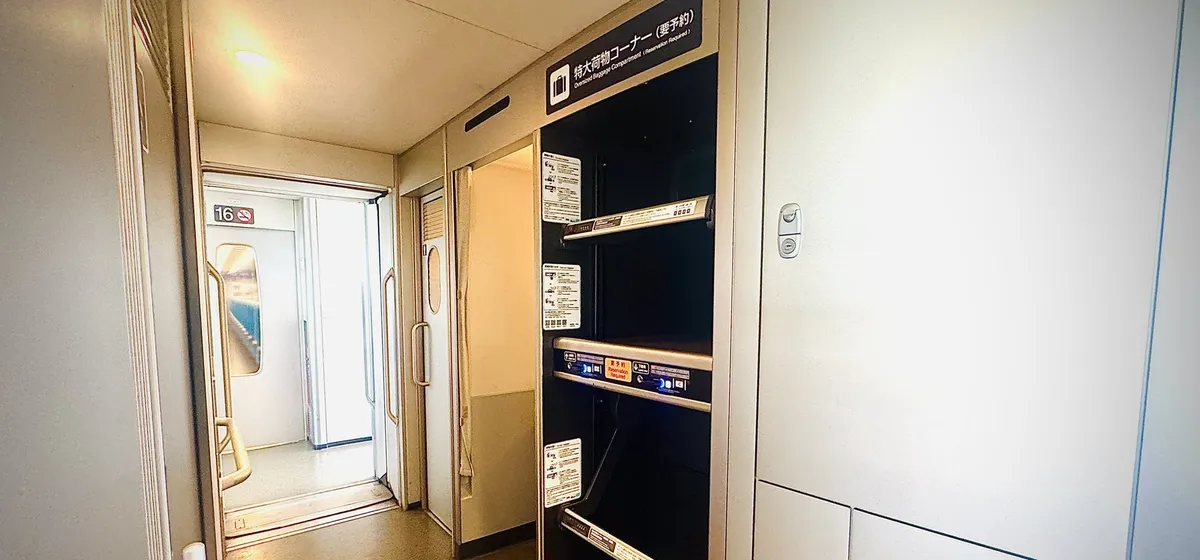
On some decks there is also an “Oversized Baggage Compartment” that JR Central is letting passengers use without a reservation, on a trial basis (JR Central, luggage information (Japanese)). The sign in the photo at the top still says “Reservation Required”, so check the latest notice before you count on it.
JR East trains need no luggage booking
On JR East’s shinkansen, such as the Tohoku, Joetsu and Hokuriku lines, you do not book luggage space (JR East, Oversized Luggage Guide). Where a train has a luggage area, it is first come, first served. The same goes for limited expresses, and some trains have no luggage area at all. If the area is full, a small suitcase goes at your feet.
In ski season, space for skis and other large items can run short.
Narita Express and Saphir Odoriko
The Narita Express has luggage spaces with dial locks, free to use on a first-come basis (JR East, Oversized Luggage Guide). The Saphir Odoriko to Izu has a large-luggage area in each of its Green Cars, cars 5 to 8 (JR East, Saphir Odoriko cars (Japanese)).
Local-train Green Cars have no luggage space
On local trains such as the Shonan-Shinjuku Line and the Tokaido Line, the Green Car has no dedicated space for large luggage (JR East, Green Cars on Local Trains). The single-level seats at each end of the car have overhead racks. JR East’s guide says nothing about where luggage goes on the upper and lower decks.

If you cannot send your suitcase ahead or leave it in a locker, the best thing you can do is avoid the rush hours.
Check how crowded a train is
The JR East app shows how crowded trains are on major lines around Tokyo, on a five-step scale, with the Green Cars shown separately (JR East, FAQ on train congestion (Japanese)). Limited expresses are not included.
Luggage on private-railway limited expresses
The Keisei Skyliner has a large-luggage area between the cabin and the deck in each car.
The Odakyu Romancecar GSE (Japanese) has space under the seats for bags, except at some seats. The end cars with the observation seats have no overhead racks, so a suitcase in the observation seats can be a squeeze.
We could not confirm luggage space on other private-railway limited expresses from their official pages, so check before you ride.
Train manners for luggage
JR East’s manners Q&A asks passengers with large luggage to do the following (JR East, Manners Q&A (Japanese)).
Summarized from JR East's "Manners Q&A"
- Keep rolling bags and other large items close to your body as you walk
- Put luggage that does not fit on the rack in a luggage area, or somewhere it does not block anyone
- Do not leave it in the aisle, in the vestibule or in front of the doors
- Lock the wheels so it cannot roll when the train sways or brakes
- Place it so it does not stop the seat in front from reclining
- When the train is crowded, put hand luggage on the rack, out of other people’s way
Take your backpack off
In a survey by the Association of Japanese Private Railways (Japanese), “the way people carry and place their bags” came seventh among the most annoying behaviors in stations and on trains. The most common complaint within it, at 27.7%, was people wearing bags on their backs. Keikyu also asks passengers to push bags all the way back on the rack and to hold backpacks in their hands rather than wear them.
Travel without your luggage
The easiest option of all is to send your big bags ahead to your hotel.
A cat in a box shaped like a delivery truck. Photo: PAKUTASO
You can send luggage from Haneda and Narita airports, from your hotel’s front desk to the airport, and from convenience stores (both pages in Japanese).
From the station to your hotel, the same day
JR East’s same-day hotel delivery takes your bags at the station and delivers them to your hotel that day (JR East, same-day hotel delivery (Japanese)). Counters include the one in front of the Shinkansen South Transfer Gate at Tokyo Station, from 9:00 to 15:00, and the baggage room on the third-floor concourse at Ueno Station, from 10:00 to 14:00. Check the official page for booking, prices and which hotels it serves.
Yamato Transport’s same-day hand-luggage delivery (Japanese) takes bags at its branches without a booking and delivers them from airports and stations to your hotel the same day. From Haneda Airport to a hotel in Tokyo’s 23 wards, for example, one piece of size 160 costs ¥5,180.
Cut-off times differ by branch.
There are even lockers that send your bags to your hotel.
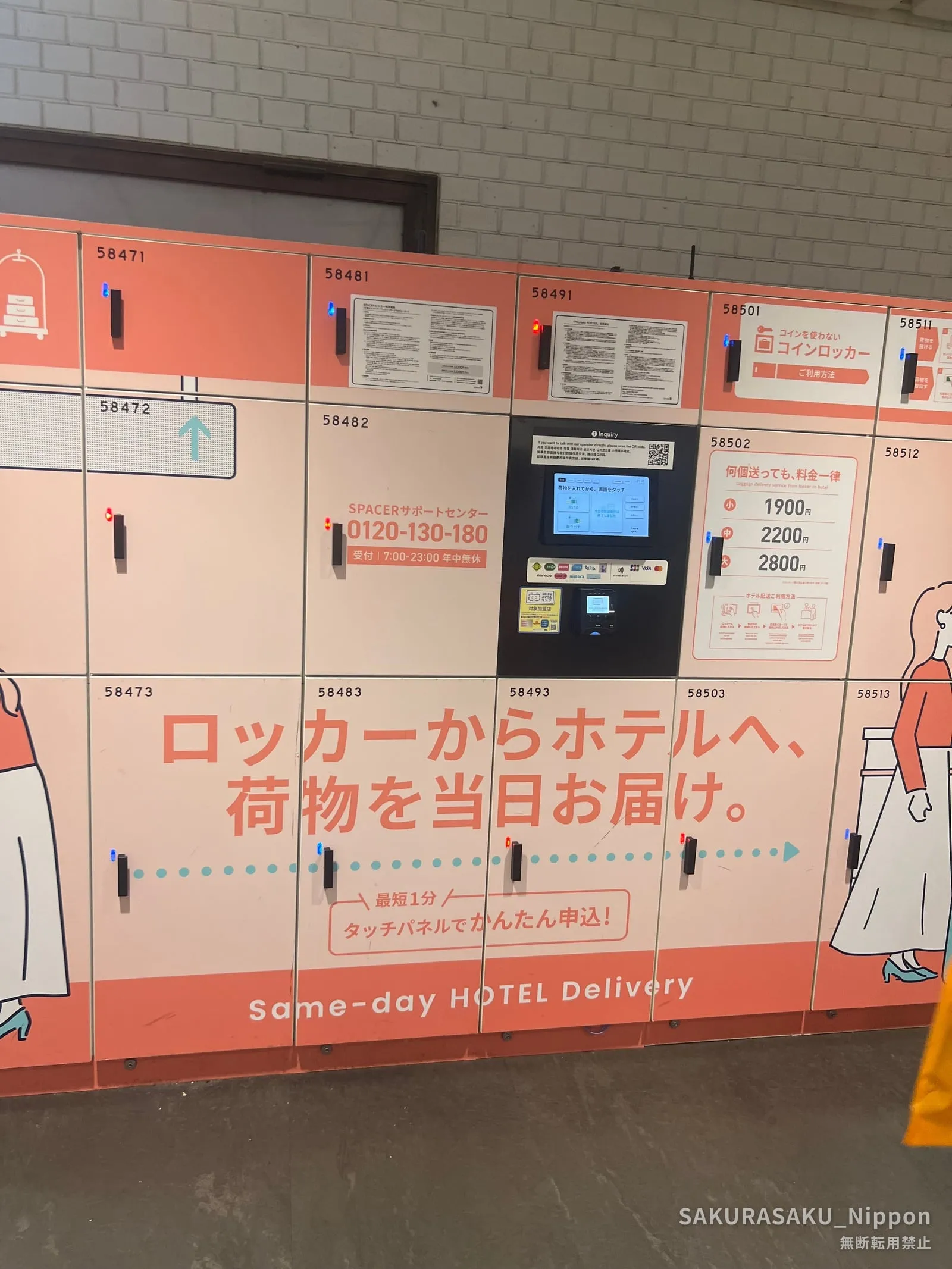
Lockers that deliver your bags to your hotel the same day. Taken in Shinjuku.
pikuraku PORTER in Tokyo (Japanese) has lockers at some Seibu and Tokyo Metro stations. Put your bags in, apply on the touch screen, and they reach your hotel in the Tokyo area by around 20:00 that day. The price depends on the door size: small ¥1,900, medium ¥2,200, large ¥2,800, however many bags fit inside. The lockers take bags until 14:00 (12:00 at some stations), and they deliver only to the hotel where you are staying that night.
Leave some slack in your plans in case the weather causes delays.
I pack my last day’s things in a backpack or a cabin-size carry-on, fill the big suitcase with souvenirs, and send it home or to the airport.
If you are arriving with a lot of luggage, or with family, a private transfer from the airport straight to your hotel saves you from carrying bags through stations at all.
\ Lots of luggage? /
↓ Airport to hotel, door to door ↓
Coin lockers in the app
The JR East app also shows where the station coin lockers are and whether they are free (JR East App).
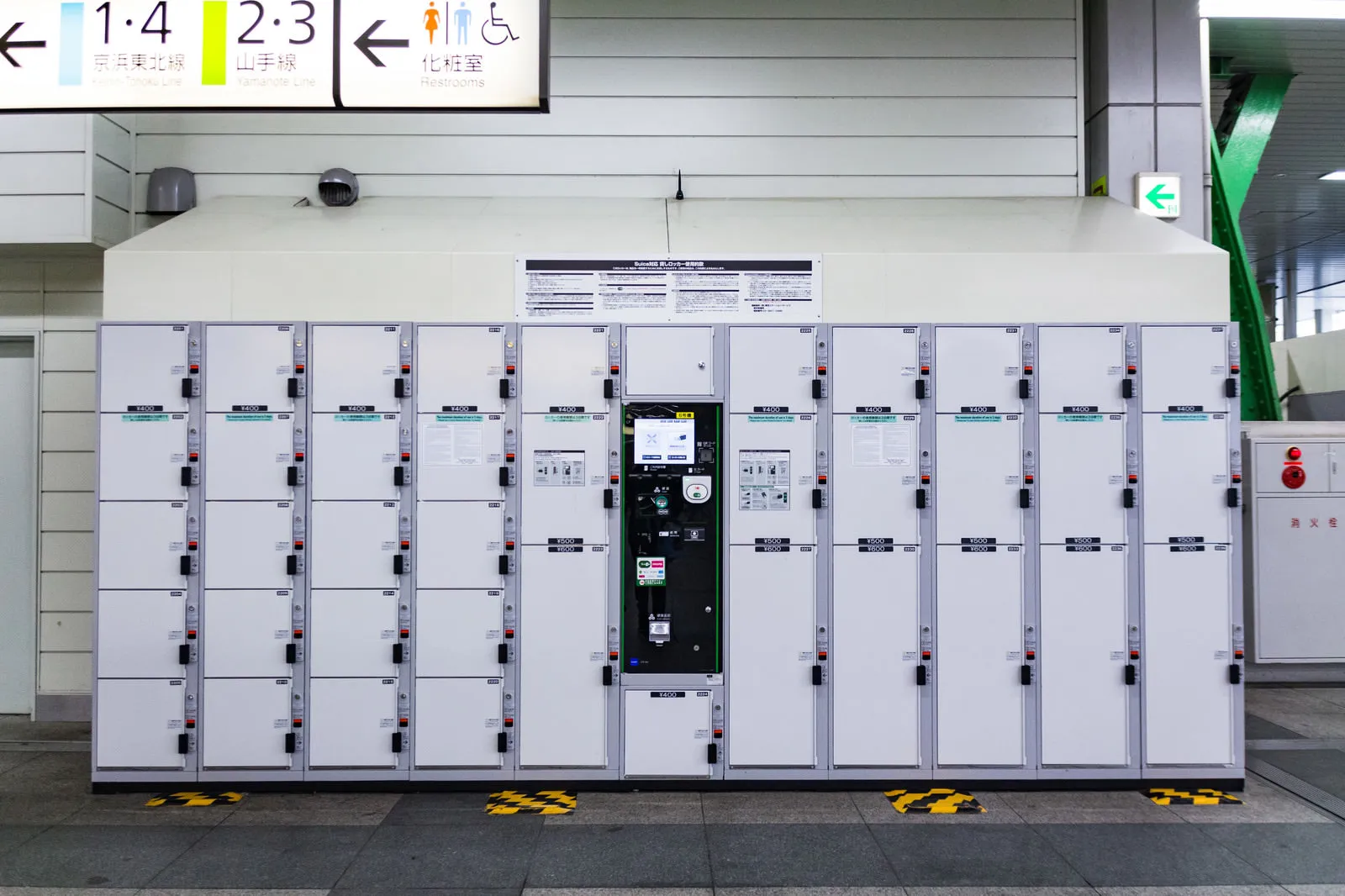
Coin lockers at a station. Photo: PAKUTASO
What should you do?
Taking an oversized bag on the Tokaido Shinkansen? Reserve a seat with an oversized baggage area.
On JR East’s shinkansen and limited expresses, no booking is needed. Use a free luggage area or keep it at your feet.
Local-train Green Cars have no space for big bags, so avoid the rush hours.
On days with a lot of luggage, send it to your hotel.
How to buy a local-train Green Car ticket is in Part 2, and how to book private-railway limited expresses and liners is in Part 7.
\ Living in Japan? /
↓ JR tickets, delivered to your door ↓

Japanese-language ad for NAVITIME Travel. Tickets are delivered to an address in Japan.
Practical information
- Checked on October 19, 2026
- JR East carry-on limits Three sides 250 cm or less in total (no side over 2 m), 30 kg or less per piece, up to 2 pieces
- Tokaido, Sanyo and Kyushu Shinkansen Bags of 161 to 250 cm need a reserved seat with an oversized baggage area (no extra charge; ¥1,000 fee without a reservation)
- JR East shinkansen No luggage booking. If the luggage area is full, keep small bags at your feet
- Local-train Green Cars No dedicated space for large luggage
- Photos The oversized baggage compartment at the top is a free stock photo from photoAC, and the cat and the coin lockers are free stock photos from PAKUTASO. All other photos are my own.
- Official pages JR East, Oversized Luggage Guide, JR Central, Oversized Baggage, JR Central, luggage information (Japanese), JR East, Green Cars on Local Trains, JR East, Saphir Odoriko cars (Japanese), JR East, FAQ on train congestion (Japanese), Keisei, Skyliner, Odakyu, GSE (Japanese), JR East, Manners Q&A (Japanese), JR East, same-day hotel delivery (Japanese), Yamato Transport, same-day hand-luggage delivery (Japanese), SPACER, pikuraku PORTER in Tokyo (Japanese), JR East App
Note: Luggage rules and services change. Please check each company’s official information before you travel.
Affiliate note: This article contains affiliate links to Kiwitaxi and NAVITIME Travel. If you book through them, we may earn a commission at no extra cost to you.