Autumn Leaves Near Tokyo 2026: Where to Go, Week by Week
I moved to Tokyo from Shanghai in the spring of 2025, so last autumn was my first autumn here. I wanted to see the famous colours, but I did not really understand when to go.
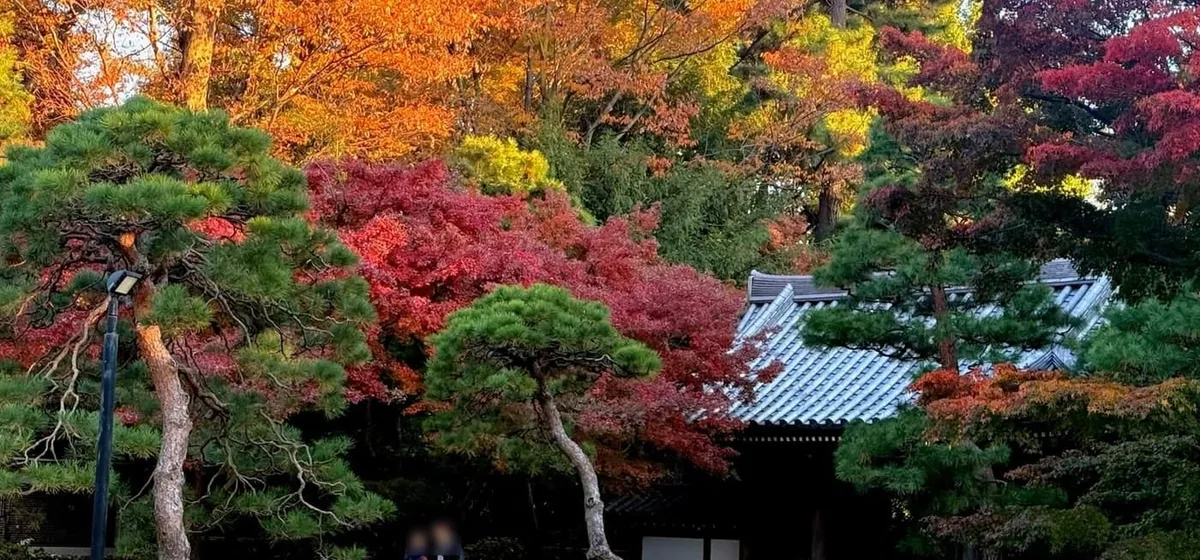
On 16 November I stood on the footbridge over Omotesando. The zelkova trees along the avenue had already turned a warm russet brown. Six days later, on 22 November, I visited a small temple in Suginami, and its maples were only then at their absolute best.
The same city, the same week, and yet each tree seemed to keep its own timetable. That is when I started to look into how autumn colour actually moves through Japan, and this guide is the result. Most of the places below I have not visited in autumn myself yet, so I have checked each one against official and weather-service information, and I will tell you honestly which is which.
How the Autumn Front Moves
In spring, Japan follows the cherry blossom front. In autumn, there is a koyo front (紅葉前線, koyo zensen) as well, and it moves in two directions at once.
- From north to south. The first colours appear in the mountains of Hokkaido in mid-September. The last ones fade in the cities of Kyushu in early December.
- From the mountain tops down to the valleys. This is the part that matters most if you are staying in Tokyo.
Japan’s weather services explain the rule in a simple way. Leaves begin to turn properly once the morning low falls below about 8°C, and they reach their peak roughly three weeks later. Because the air becomes about 0.6°C cooler with every 100 metres you climb, the mountains reach that point first.
Around Tokyo, the difference is surprisingly large. The highlands of Okunikko sit at about 1,400 metres, and their colours peak almost two months earlier than the ginkgo trees in central Tokyo. If your trip falls anywhere between early October and mid-December, there is somewhere within a day trip of Tokyo where the leaves are at their best. You only need to know which height to look at.
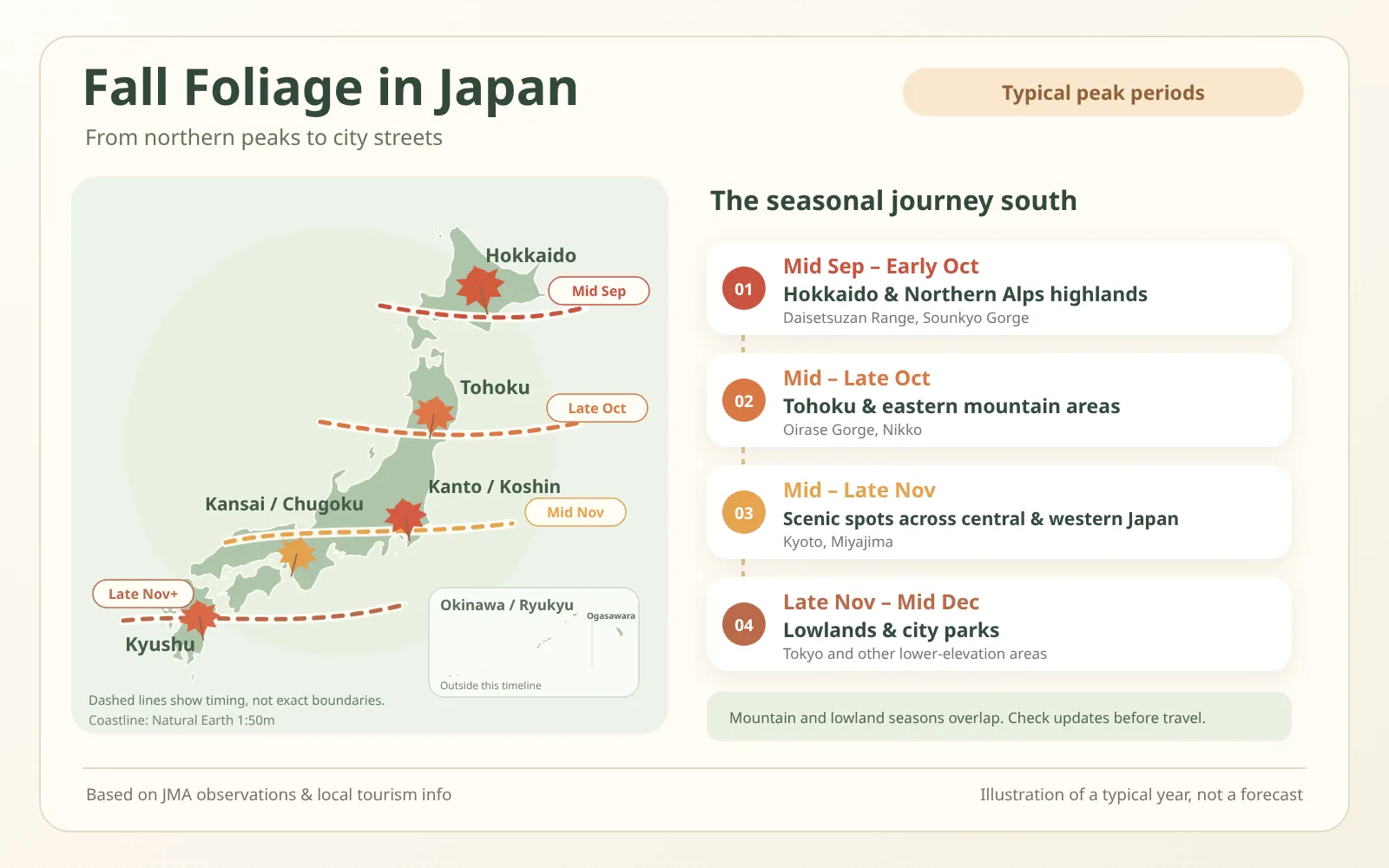
This is my own illustration of a typical year, not a forecast. The dashed lines only show rough timing. For this year’s dates, please check the latest official forecasts.
This Year (2026)
This section is updated each autumn.
Japan’s weather services publish an autumn leaves forecast every year, from early September, and update it several times during the season. In 2026, they expect a warm autumn, with temperatures staying higher than usual into November, so the colours in eastern Japan are likely to arrive around the usual time or a little later.
The dates in this guide are the usual peak periods, taken from local tourism associations. For this year’s forecast dates, please check the latest version shortly before you go: tenki.jp autumn leaves forecast (Japanese) and Weathernews koyo news (Japanese).
Quick Planner: Where to Go When
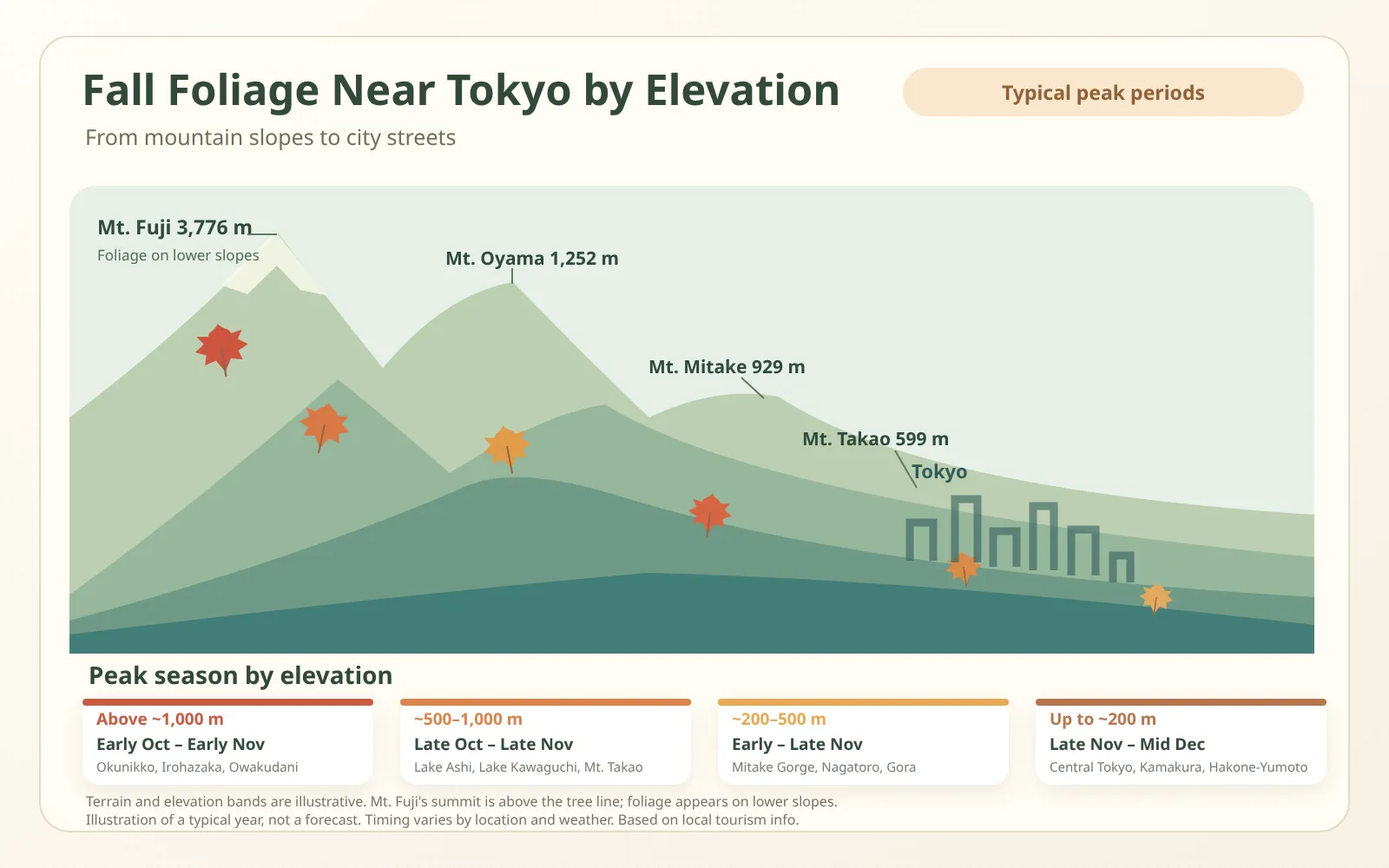
The mountains and distances in this illustration are not to scale.
These are the usual peak periods. In a warm year, everything may shift a little later.
| When you visit | Where the leaves are best | Height |
|---|---|---|
| Early–mid October | Okunikko (Senjogahara, Yudaki and Ryuzu Falls) | about 1,300–1,400 m |
| Mid October–early November | Nikko: Irohazaka road, Lake Chuzenji, Kegon Falls | about 800–1,300 m |
| Late October–mid November | Upper Hakone: Sengokuhara, Owakudani, Lake Ashi | about 700–1,000 m |
| Early–late November | Lake Kawaguchi (Momiji Corridor), Mitake Gorge | about 230–830 m |
| Mid–late November | Mt Takao, Nagatoro, middle Hakone (Gora, Miyanoshita) | about 200–600 m |
| Late November–early December | Central Tokyo: Rikugien, Jingu Gaien, Omotesando; Hakone-Yumoto; Kansen-ji; Otaguro Park | below 100 m |
| Late November–mid December | Kamakura (the last of the season) | near sea level |
Now, from the top of the mountains down to the city.
1. Okunikko: The First Colours (Early–Mid October)
Beyond Lake Chuzenji, the land rises into Okunikko, a high plateau of marshland, waterfalls and birch forest at around 1,300–1,400 metres. According to the Nikko tourism association, Ryuzu Falls (Ryuzu-no-taki) is usually the first place in Nikko to change colour, beginning in late September and peaking in early to mid October. Yudaki Falls peaks at about the same time, and the trees of Senjogahara marsh follow in mid to late October.
If you are in Japan in early October and feel that you have “come too early” for autumn, this is your answer.
- Access: Tobu Railway from Asakusa to Tobu-Nikko (about 1 hour 50 minutes by limited express), then a Tobu bus up the Irohazaka road and past the lake (about 1 hour more to Ryuzu Falls)
- Good to know: It is noticeably colder up here. Please bring a warm layer even if Tokyo still feels like summer.
📍 Open in Google Maps: Ryuzu Falls
2. Nikko: Irohazaka and Lake Chuzenji (Mid October–Early November)
The Irohazaka road climbs from the town of Nikko to Lake Chuzenji (about 1,270 m) in 48 hairpin bends, and in autumn the whole mountainside turns red and gold. The tourism association gives the usual peak as mid October to early November. Kegon Falls, where the lake drops 97 metres, is at its best in the same period.
I must be honest about one thing: on autumn weekends, the Irohazaka road is one of the most congested roads in the Kanto region. The bus from the station to the lake normally takes about 45 minutes, but on a peak weekend it can take much, much longer. If you can, please go on a weekday and leave Tokyo early. A guided bus tour does not avoid the traffic, but it does mean you do not have to worry about connections.
If you would rather not plan the connections yourself, there is an autumn-only day tour from Tokyo that covers the Irohazaka road, Kegon Falls, Lake Chuzenji and Toshogu Shrine. Guides speak English or Korean, and the day is long, about 12 hours.
Nikko Autumn Special: Irohazaka, Kegon Falls & Toshogu Day Tour

I have written a full one-day plan for Nikko here: Nikko Day Trip from Tokyo.
📍 Open in Google Maps: Lake Chuzenji
3. Hakone: Ride Down Through the Season (Late October–Early December)
Hakone is the best place near Tokyo to see the autumn front with your own eyes, because one railway line runs right through it.
The Hakone Tozan Railway climbs from Hakone-Yumoto (about 100 m) to Gora (about 540 m) by switchbacks, and from Gora a cable car and ropeway carry you on to Owakudani (about 1,000 m) and down to Lake Ashi (about 720 m). In local guides, the usual peaks follow the height:
- Sengokuhara, Owakudani and Lake Ashi: late October to mid November
- Gora and Miyanoshita: November
- Hakone-Yumoto and Tonosawa, at the bottom: late November to early December
In mid November, it is often possible to see bare branches at the top, full colour in the middle, and green leaves at the bottom, all on the same day.
The Hakone Free Pass covers the Tozan Railway, the cable car and the ropeway, so you can ride down through the colours and stop wherever they look best.
Hakone Free Pass — unlimited rides on the trains, cable car and ropeway around Hakone

For the route and the timing, please see my Hakone Day Trip from Tokyo.
📍 Open in Google Maps: Hakone-Yumoto Station
4. Lake Kawaguchi: Maples and Mt Fuji (Early–Late November)
The Momiji Corridor (momiji kairo) on the north shore of Lake Kawaguchi is a short tunnel of old maple trees beside a stream, at about 830 metres. On a clear morning, you can see Mt Fuji from the lake shore nearby, and that is why this place is so popular with visitors from abroad.
- Festival: The Fujikawaguchiko Autumn Leaves Festival runs from 7 to 29 November 2026, with the maples lit up from sunset until 22:00 (according to the official Fujikawaguchiko tourism site)
- Access: Highway bus from Busta Shinjuku to Kawaguchiko Station (about 1 hour 45 minutes), then the sightseeing bus to the “Itchiku Kubota Art Museum” stop, about one minute from the corridor
- Good to know: On weekends in November, the roads around the lake become very crowded. Early morning on a weekday is the calmest time. Mt Fuji is often clearest in the morning, too.
There are also day tours from Tokyo that visit the Momiji Corridor and nearby Lake Yamanaka in one day, with an English-speaking guide. The one below runs only in the autumn season and is still a new listing, so it has only a few reviews so far.
Mount Fuji Twin Lakes Autumn Leaves Day Tour — Kawaguchiko Momiji Corridor & Lake Yamanaka

📍 Open in Google Maps: Momiji Corridor, Lake Kawaguchi
5. Mt Takao: Tokyo’s Own Mountain (Mid–Late November)
Mt Takao is only 599 metres high, and about 50 minutes from Shinjuku on the Keio Line. In mid to late November, maples line the paths near the top, and the colour moves slowly down to the station at the foot of the mountain.
Mt Takao is lovely, but it is also very well known. On a sunny Sunday in November, the queue for the cable car can be long and the main path to the top is busy. A weekday morning makes a real difference here too.
📍 Open in Google Maps: Takaosanguchi Station
6. Mitake Gorge: A Quiet River Walk (Early–Late November)
If you would like something calmer, Mitake Gorge (Mitake keikoku) is my suggestion. A walking path follows the clear Tama River for a few kilometres, starting right next to Mitake Station on the JR Ome Line, about 1 hour 30 minutes from Shinjuku. The trees along the river are a mix of maple, ginkgo and zelkova, so the colours are varied. Local information gives the usual peak as early to late November.
There is no entry fee. You simply walk along the river, and turn back whenever you like.
📍 Open in Google Maps: Mitake Gorge
7. Nagatoro: Red Maples on the River (Mid–Late November)
Nagatoro in Saitama is famous for its terraced riverside rocks, and in autumn the maples along the Arakawa River turn red. The best-known spot is Tsuki-no-Ishi Momiji Park, a short walk from Kami-Nagatoro Station, where the maples are lit up in the evening during the autumn festival.
From Tokyo, the comfortable way is the Seibu Laview limited express from Ikebukuro to Seibu-Chichibu, then the Chichibu Railway. I have written about both: Nagatoro and the Iwadatami rocks and Fifty-two Seats of Happiness, Seibu’s restaurant train to Chichibu.
📍 Open in Google Maps: Tsuki-no-Ishi Momiji Park
8. Central Tokyo: The Gardens and the Avenues (Late November–Early December)
When the mountains are finished, the city begins. In central Tokyo, the colours usually peak from late November into early December, and you do not need to leave the train network at all.
Rikugien Garden
Rikugien is a classical Edo-period garden in Komagome, about 7 minutes on foot from Komagome Station (JR Yamanote Line). In late November, the maples around the old teahouse turn deep red.
- Entry: ¥300 (9:00–17:00, last entry 16:30)
- Night viewing 2026: 25 November to 6 December, 18:00–20:30 (last entry 19:30). A separate ticket is needed: ¥1,000 online in advance, or ¥1,200 on the day (the gate counter accepts cash only). Daily numbers are limited.
📍 Open in Google Maps: Rikugien Garden
Jingu Gaien Ginkgo Avenue and Omotesando
In Tokyo, autumn is not only red. The Jingu Gaien Ginkgo Avenue near Gaienmae Station is a long, straight road under rows of tall ginkgo trees, and in late November it becomes a corridor of bright yellow. The festival with food stalls is usually held at the same time; please check the dates each year.
From there, it is a pleasant walk to Omotesando, where the zelkova trees turn a softer russet and gold. In my experience, they change a little earlier than the maples and the ginkgo.
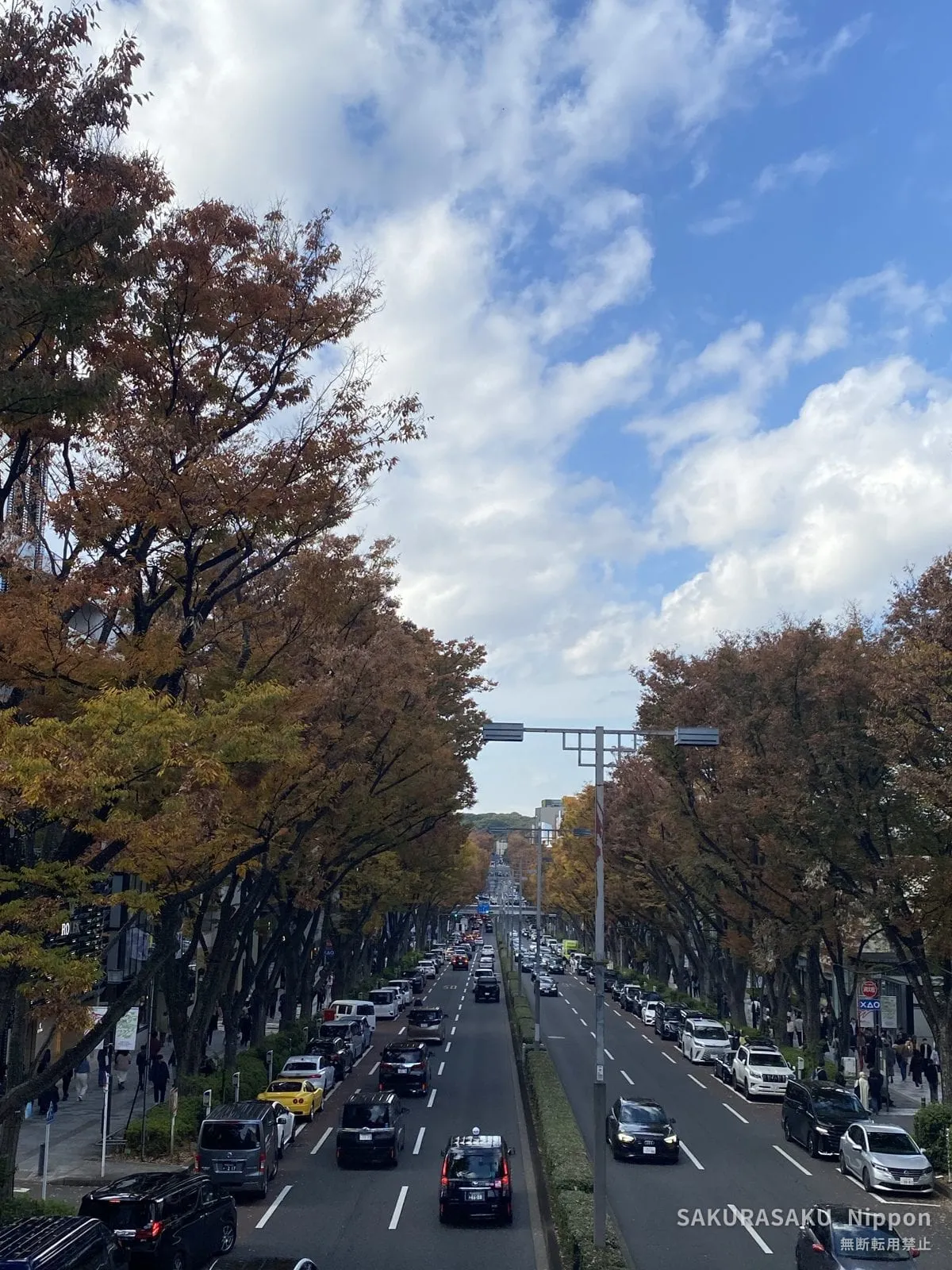
This is the avenue on 16 November 2025, from the footbridge. The zelkovas were already well coloured, while most of the city’s maples were still waiting. So if you are in Tokyo in mid November, Omotesando is a good place to start.
📍 Open in Google Maps: Jingu Gaien Ginkgo Avenue
9. Kamakura: The Last of the Season (Late November–Mid December)
Kamakura sits by the sea, and the sea keeps it warmer in late autumn. That is why it is one of the last places near Tokyo where you can still see autumn colour. The Kamakura tourism association gives the usual peak as late November to early December, and in the temple gardens of Kita-Kamakura, such as Meigetsu-in and Engaku-ji, some trees are still beautiful into December.
If your trip is in early December and you think autumn is over, please try Kamakura.
The temples of Kamakura are places of worship. Please keep your voice low, stay on the paths, and follow the signs about photography inside the halls.
Kamakura Day Trip from Tokyo — Great Buddha, Enoden, Kamakurakokomae, Enoshima, Tsurugaoka Hachimangu

My full plan for the day is here: Kamakura Day Trip from Tokyo.
📍 Open in Google Maps: Meigetsu-in
Hidden Gems in Suginami: Kansen-ji Temple and Otaguro Park
Finally, the temple from the beginning of this story.
Kansen-ji is a quiet Zen temple in a residential area of Suginami, in western Tokyo. When you stand under its old gate, the maples and the main hall behind it look like a picture in a frame. Entry is free, and on a weekday morning there are very few people.
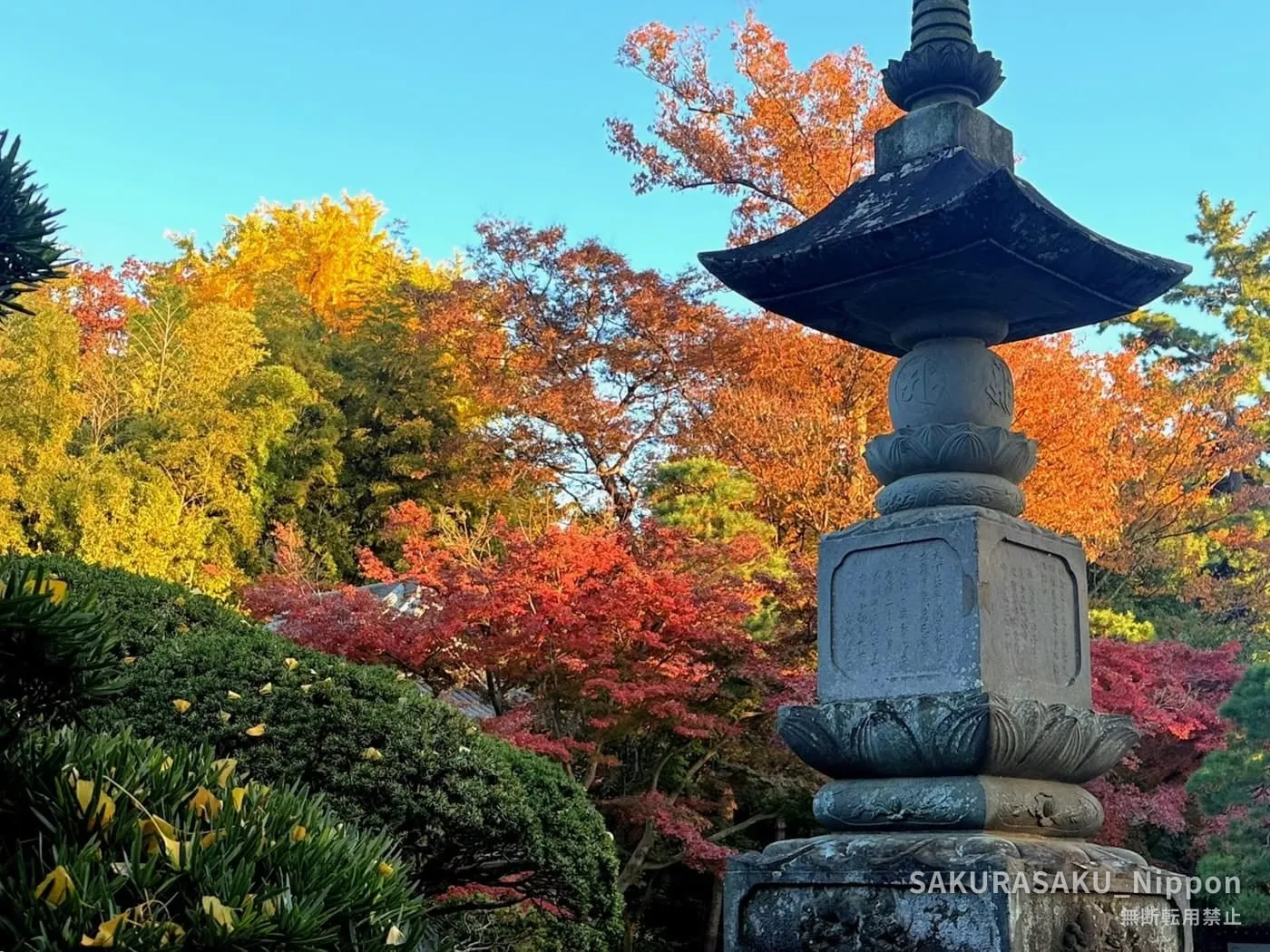
I took this photo on 22 November 2025, six days after my walk on Omotesando. It was the best day of my first Tokyo autumn.
Kansen-ji is a working temple with a cemetery, not a tourist attraction. Entry is free because it is not a business. Please speak quietly, stay on the garden paths, and do not take photos inside the halls or of the graves.
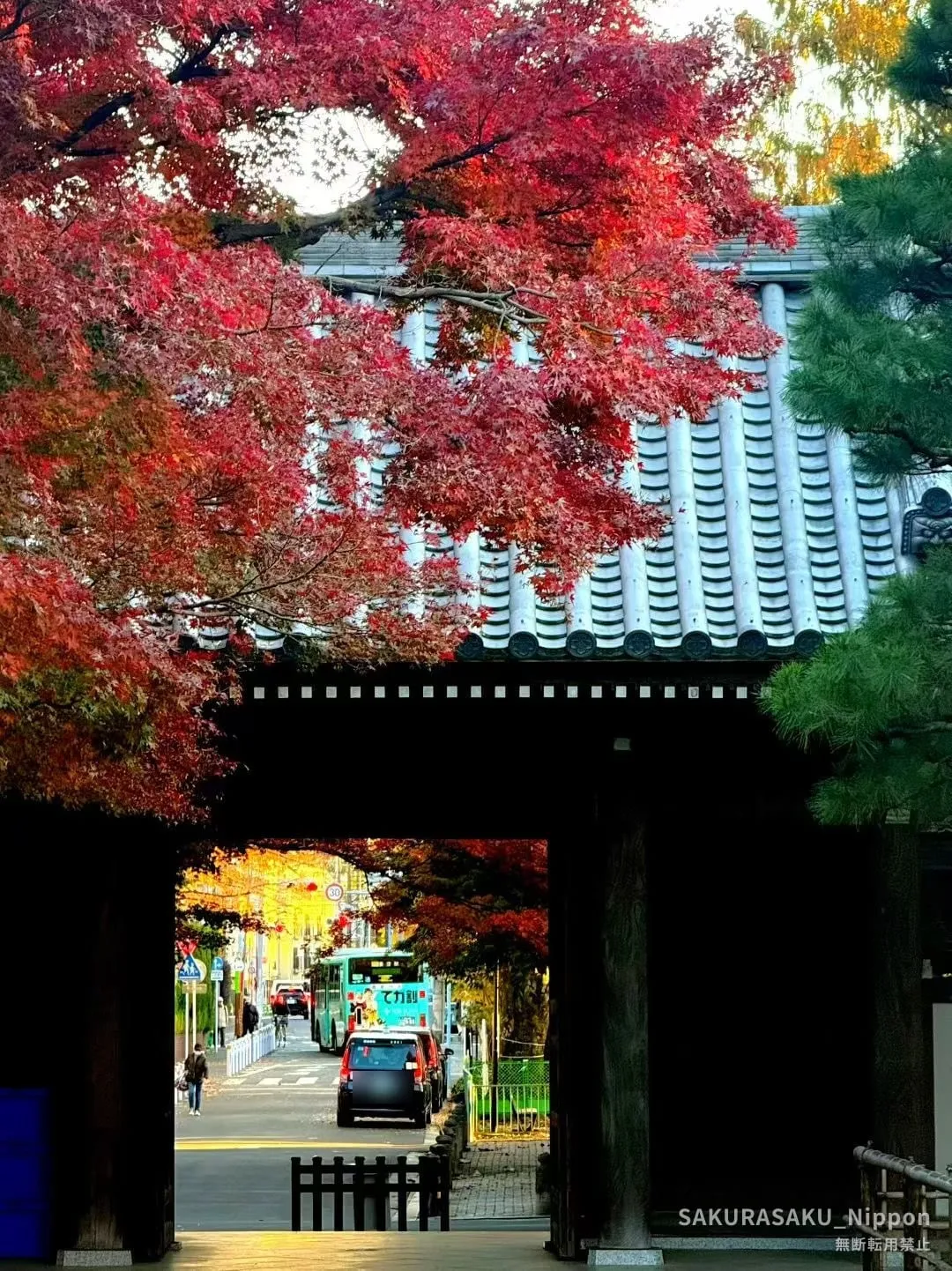
Turn around under the gate and the street outside is an ordinary neighbourhood road, buses and all. This is a temple that people live right next to, not a sightseeing spot.
I have written about the temple and its unexpected history here: Kansen-ji: Kyoto-Style Autumn Colour, Inside Tokyo.
📍 Open in Google Maps: Kansenji Temple
For Autumn Colour After Dark: Otaguro Park
Otaguro Park, also in Suginami, is a Japanese garden about a 10-minute walk from Ogikubo Station (JR Chuo Line and Tokyo Metro Marunouchi Line). It stands on the former estate of the music critic Motoo Otaguro, and Suginami City opened it as a public park in 1981. By day, entry is free (9:00–17:00, last entry 16:30, closed on Wednesdays).
For about ten days near the end of the season, the garden is lit up at night.
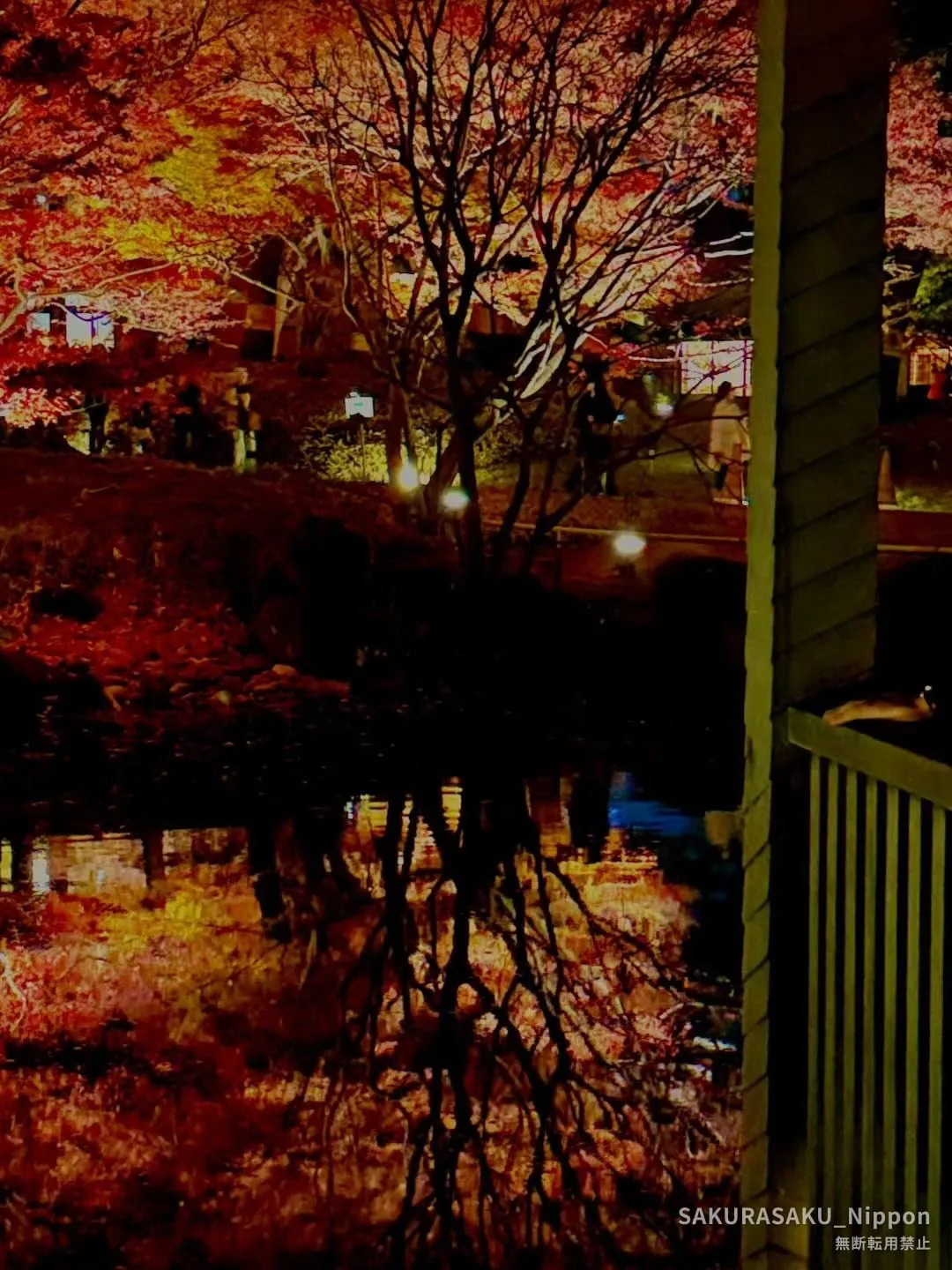
I took these photos at the 2025 light-up. The lit maples appear a second time, upside down in the pond.
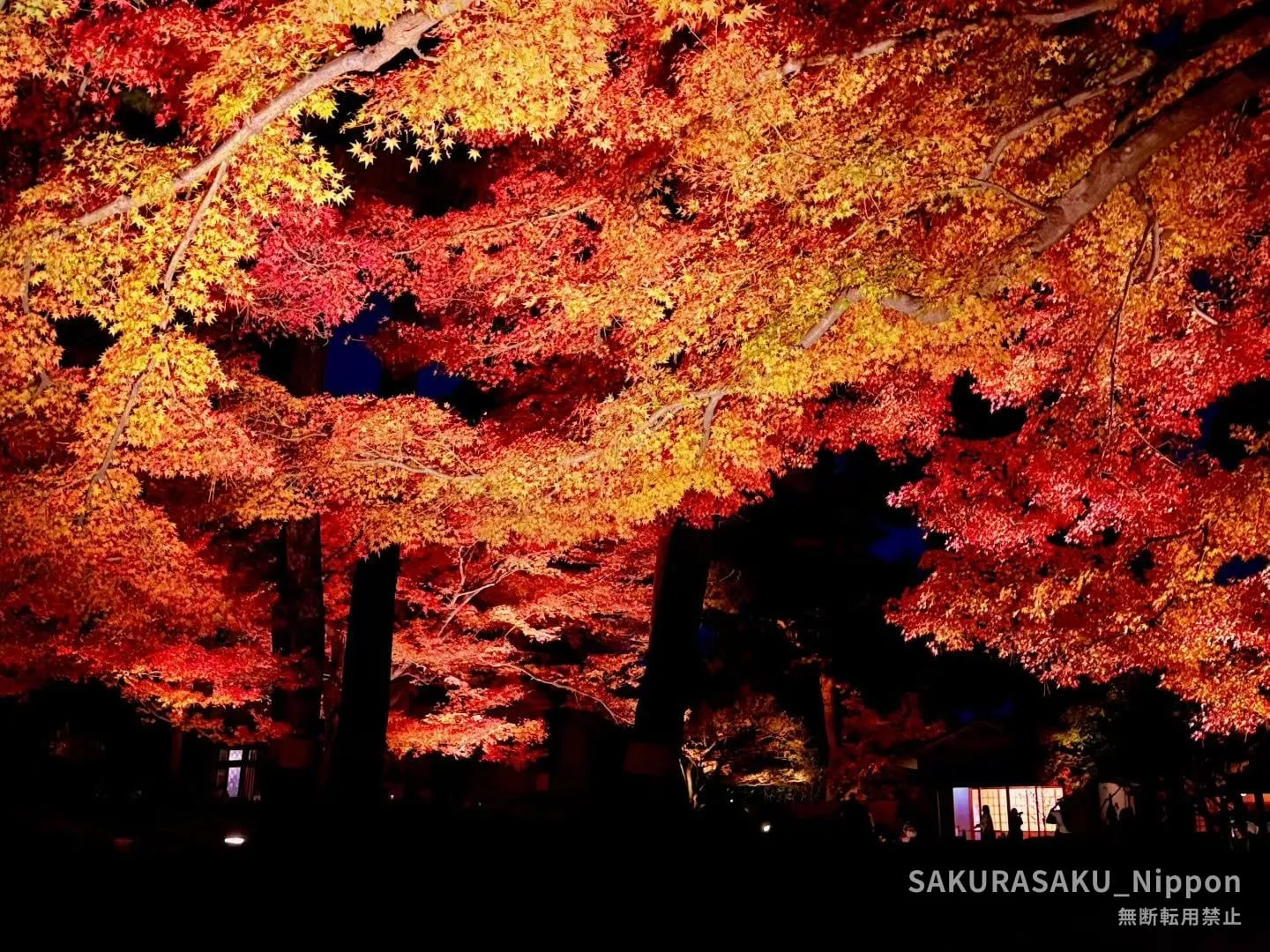
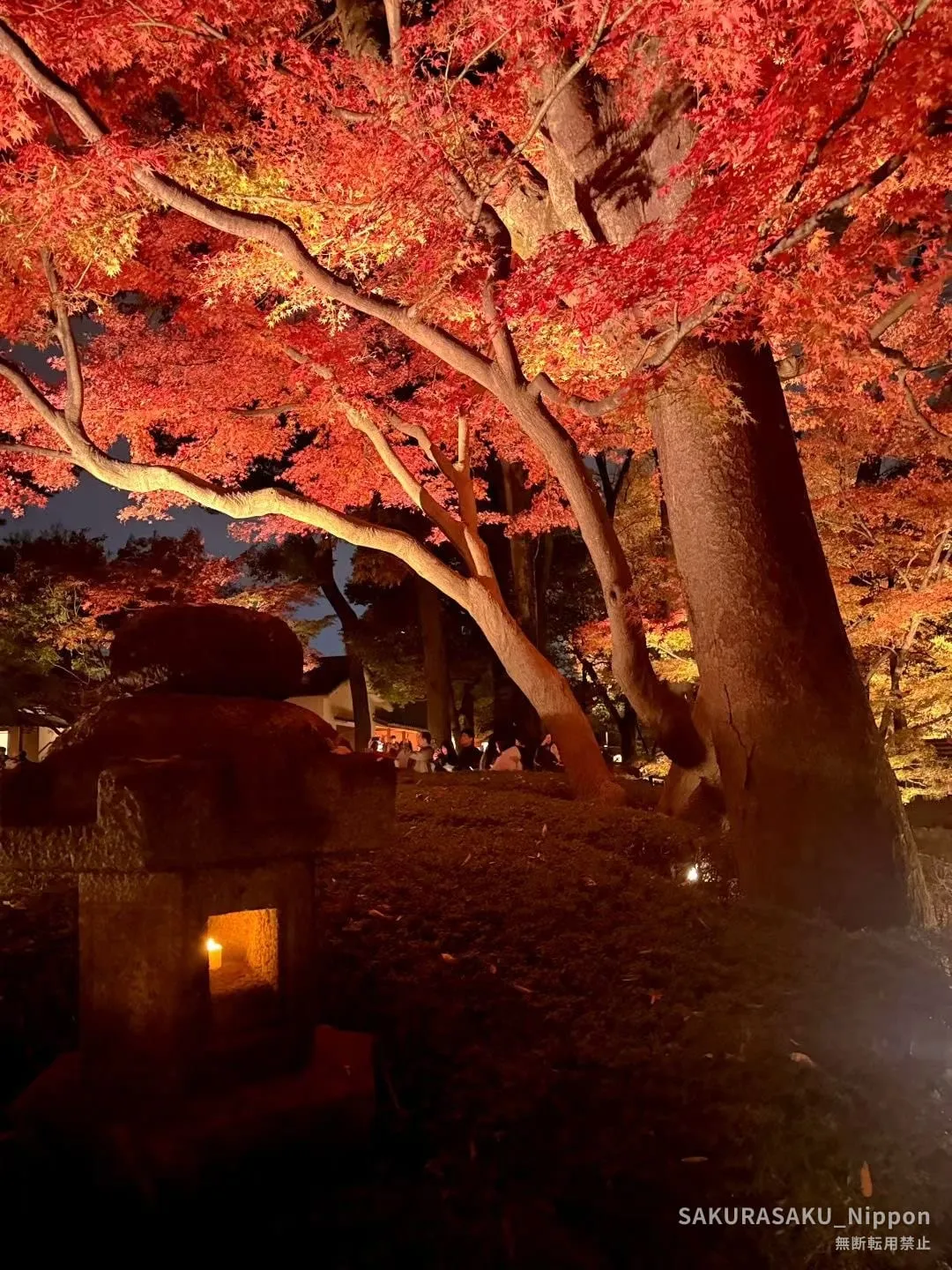
- The 2025 dates, as an example: 28 November to 7 December, 17:00–20:00 (until 21:00 Friday to Sunday). Adults ¥300, elementary and junior high school students ¥100, preschool children free.
- Good to know: On light-up days the park closes at 16:30 and reopens for the evening at 17:00. It also opens on Wednesdays during the event. It gets very crowded.
- The dates change every year, so please check Suginami City’s official website before you go.
📍 Open in Google Maps: Otaguro Park
Practical Tips
- Check the forecast again a week before. The usual dates in this guide are a starting point. A warm October can move everything later by a week or more.
- Go on a weekday, and go early. This advice applies to almost every place in this guide, but most of all to Nikko, Lake Kawaguchi and Mt Takao.
- Dress for the height, not for Tokyo. At 1,000 metres it is about 6°C cooler than in the city, and mornings in the mountains can be close to freezing in late October.
- Peak lasts about two weeks in any one place. If you miss it, simply go lower, or further south.
Note: Peak periods, festival dates, prices and opening hours change from year to year. Please check the official sites before your visit. Usual peak periods come from the local tourism associations; the 2026 festival and night-viewing dates come from the Fujikawaguchiko tourism site and the Tokyo Metropolitan Park Association; the Otaguro Park light-up details come from Suginami City (2025).
Affiliate note: This article contains Klook affiliate links. If you book through them, we may earn a small commission at no extra cost to you.